Guides / Martial arts
Guide · Martial artsHow to decide when a student is ready for their next belt
Every school promotes differently, and that is fine. What students and parents notice is when the rules change from one student to the next. Written criteria, tracked the same way for everyone, fix that.
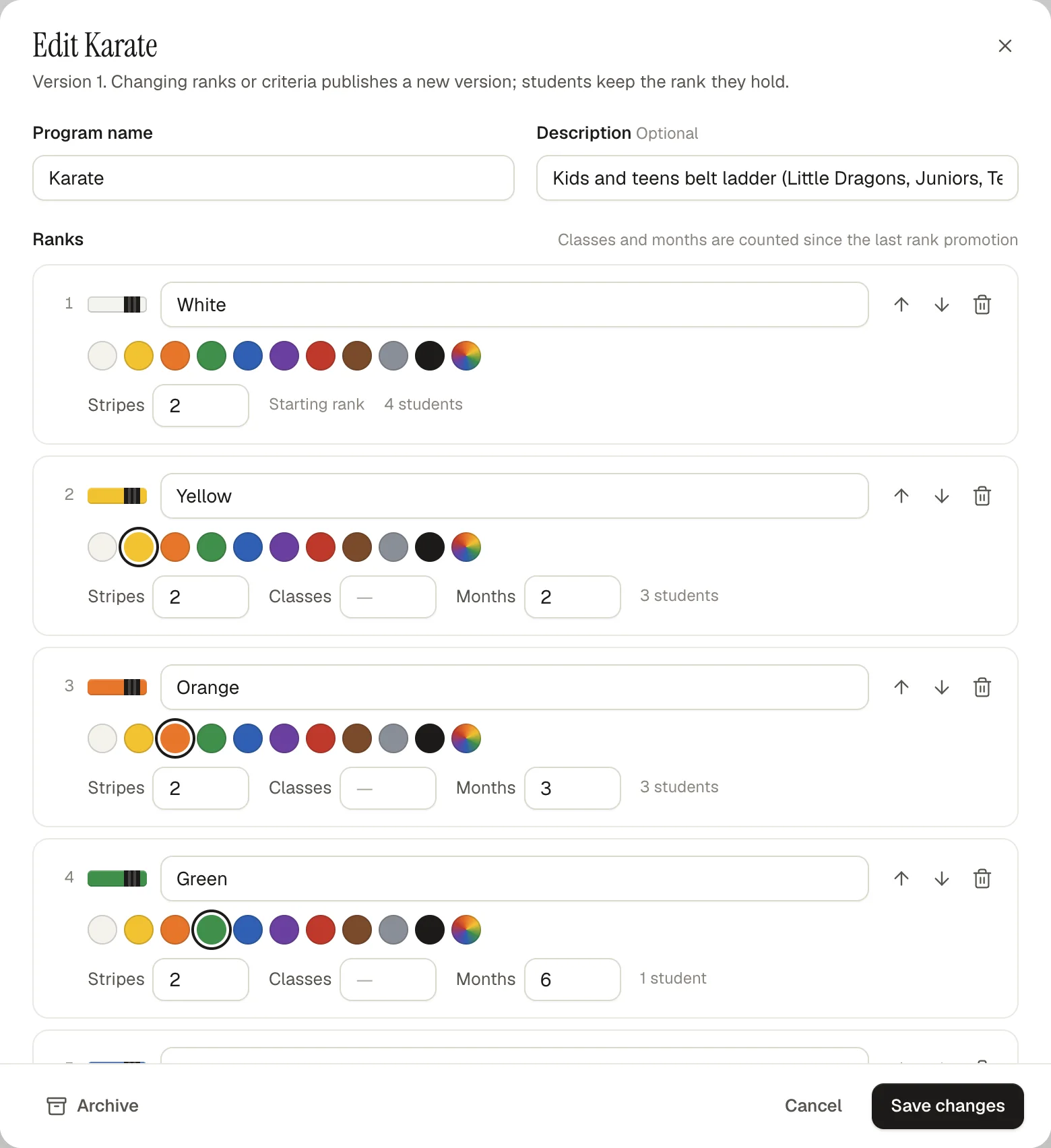
The short version
- Most schools weigh four things: attendance, time at rank, technique and conduct.
- Attendance and time are signals that a student might be ready. A coach still makes the call.
- Write the criteria down for every rank, and make later ranks longer than early ones.
- Count classes since the last promotion, not since the student joined.
- Show students and parents their progress, so a promotion never comes out of nowhere.
Ask ten instructors how they decide a student is ready for their next belt and you will get ten good answers. That is not the problem. The problem starts when the answer changes from one student to the next, and a parent asks why their child waited six months longer than a friend in the same class.
Written criteria fix that. They do not take the decision away from the coach. They make sure every student is measured the same way, and that nobody's progress depends on a coach remembering who came to class in March.
The four things most schools weigh
Whatever the art, promotion decisions usually come down to the same four inputs. Attendance and time at rank are easy to count. Technique and conduct need a coach's eye.
The first two are signals. When a student reaches the classes and the time for their rank, they are ready to be looked at, not automatically promoted. That one distinction removes most of the arguments about attendance-based promotions: attendance earns a student the hours to learn, and the coach decides whether they learned it.
Set the numbers for each rank
There is no universal standard for how many classes sit between belts, and there should not be. A school that trains three times a week needs different numbers from one that trains once. What matters is that you choose numbers you can explain, write them down, and use them for everyone.
Three rules make the numbers work:
- Count since the last promotion, not since the student joined. Otherwise a long-time student who stalled looks ready on paper.
- Make later ranks longer. Early belts reward showing up. Later belts reward depth, and the gaps should grow.
- Base it on a normal week. Many schools assume about two classes a week, then let time at rank catch students who train less.
| Next belt | Classes since last belt | Months at current belt | Stripes on the way |
|---|---|---|---|
| Yellow | 16 | 2 | 2 |
| Orange | 20 | 3 | 2 |
| Green | 24 | 3 | 2 |
| Blue | 28 | 4 | 2 |
| Purple | 32 | 4 | 2 |
| Brown | 40 | 6 | 3 |
Brazilian jiu-jitsu runs on much longer timescales, and federations publish their own rules. The IBJJF graduation system, for example, sets minimum ages and minimum times at each adult belt for its competitors. If your students compete, build those minimums into your own criteria.
Stripes: smaller steps between belts
For kids, a belt can be a long way off. Stripes break that wait into steps a child can see and count, and they give coaches a regular moment to say what is going well and what to work on next. Treat each stripe as a mini-promotion with its own small criteria, such as a set number of classes or a technique shown.
Adults like visible progress too. In arts with long gaps between belts, stripes are often the main way a student knows they are on track.
Gradings or in-class promotions?
Both models work. Most schools pick one, and some use both: gradings for kids, in-class promotions for adults.
| Grading days | In-class promotions | |
|---|---|---|
| How it works | Students who meet the criteria are invited to a test on a set date. | The coach promotes a student during a normal class when they are ready. |
| Best for | Kids programs and arts with a fixed curriculum per belt. | Arts judged over months of live training, like jiu-jitsu. |
| Families | A clear event to plan for and attend. | A surprise moment, usually celebrated on the mat. |
| Watch out for | Students who meet the numbers but are not ready to test. | Inconsistency between coaches without written criteria. |
Kids are a different program
Children progress differently from adults, and most schools run a separate ladder for them: more ranks, smaller steps, and stripes in between. Group them by age as well as rank, so a seven-year-old is not measured against a twelve-year-old.
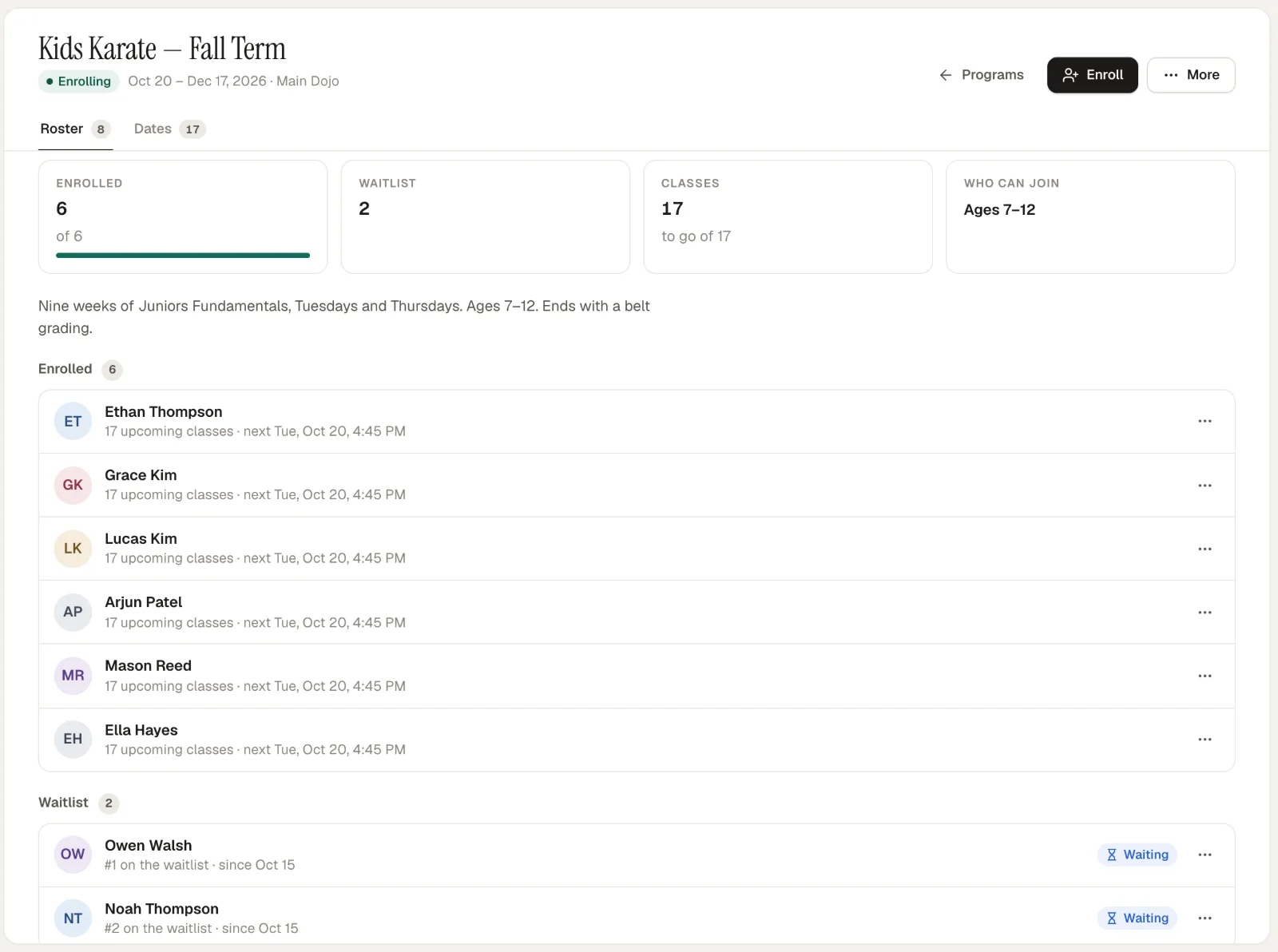
Parents are part of the picture too. They pay, they drive, and they want to know how their child is doing. A parent who can see attendance and progress for each child is far less likely to be surprised by a promotion, or by a wait. Our families page shows how one parent can follow several children from one sign-in.
Track readiness without a spreadsheet
Most schools start with a spreadsheet, and most outgrow it the same way: it is only as current as the last time someone updated it, and only one person really trusts it. Whatever you use, it should do four things.
- Count classes and time since each student's last promotion, from real check-ins.
- Show who has reached the criteria, and who is close, without anyone adding it up.
- Leave the decision to a coach, and record who promoted whom and when.
- Show students and parents their own progress.
In Classwell you set your own ladder of belts, stripes, levels or grades, with the classes and months each step usually needs. Attendance from check-ins counts toward the next step, the promotions view shows who is ready for review, and a coach approves every promotion. Members and parents see their progress in the app.
Common promotion mistakes
Most promotion complaints trace back to a handful of habits. They are easy to fix once you can see them.
- Promoting by memory. The students the coach sees most get noticed first. Counting check-ins gives quieter students the same chance.
- Counting from the join date. A student who joined two years ago and stalled at green looks overdue on paper. Count from the last promotion.
- Changing the bar mid-term. If you raise the criteria, apply the new numbers from the next rank onwards, not to students already close.
- Treating the count as a promise. Hitting the numbers makes a student eligible, not entitled. Say so in your published rules, kindly and clearly.
- Forgetting the student who trains elsewhere. Visitors, transfers and students at a second location need their time counted too, or a note explaining why it is not.
Tell students and parents the rules
Publish your criteria. A one-page sheet in the lobby, or a page in your member app, answers most "when is my child getting their next belt?" questions before they are asked. Students work harder toward a target they can see. It does not need to be long.
How promotions work at Cedar Martial Arts (kids program)
Each belt has a number of classes and a minimum time since the last belt. When your child reaches both, their coach starts watching for the techniques on that belt's list, and for effort and respect in class.
When the coach is happy, your child is invited to the next grading. You can see their classes and progress in the app at any time. Questions? Ask any coach after class.
And when a promotion happens, make it count. A belt is a big deal to the person wearing it. Running kids terms with gradings at the end? See howprograms and terms handle age rules and waitlists, and how Classwell works for martial arts schools.
Questions owners ask
How many classes should a student take between belts?
There is no standard. Many kids programs set roughly 15 to 30 classes for early belts, assuming about two classes a week, and raise the number at each rank. Choose numbers you can explain, and write them down.
Should attendance alone earn a belt?
No. Attendance shows commitment and gives a student the hours to learn, but it does not show skill. Treat it as the point where a coach starts watching for readiness, not as the promotion itself.
How long does it take to reach black belt?
It depends on the art, the school and how often the student trains. Some styles award a junior black belt within a few years; Brazilian jiu-jitsu commonly takes around a decade. Federations such as the IBJJF publish minimum times at each adult belt.
Are stripes worth tracking?
For kids, almost always. Stripes break a long wait into steps a child can see, and they give coaches a regular moment to give feedback.
Should we hold gradings or promote in class?
Both work. Gradings make a clear event for families and suit striking arts with a set curriculum. Promoting in class suits arts like jiu-jitsu, where the coach watches progress over months. Some schools use gradings for kids and in-class promotions for adults.
Sources
- IBJJF graduation system, International Brazilian Jiu-Jitsu Federation
Read next
 Front desk · 6 min read
How to set up a self check-in kiosk for your gym
A tablet by the door can take check-ins off your front desk entirely, if it is in the right place, locked to one app and set up with sensible rules. This is what we learned setting one up at a busy gym. Waivers · 6 min read
Gym liability waivers: what to include and how to manage them
A waiver only helps if it is clear, signed by the right person, and signed before they train. Here is what most gym waivers cover, where state law changes the picture, and how to run them without a filing cabinet. Choosing software · 7 min read
How to choose gym management software: a checklist for small gyms
Feature lists all look the same. The differences show up on a busy Monday evening, in the payment terms and on the day you want to leave. This checklist tests for those.See it on a real schedule, not a sales call.
The demo gym runs on sample data. Click through the Today screen, the kiosk, the member app and a Glofox switch. No sign-up.